
Plenty of FPL managers are running a UCL Fantasy team alongside their main squad this season. The two games look alike on the surface, but the rules, chips and scoring pull your decisions in different directions. Here's what changes when you switch between them, and how to use data to stay ahead in both.
The week of 10 to 14 October shows the overlap well. Premier League Gameweek 6 runs from Saturday to Monday, and UEFA Champions League Matchday 2 kicks off the following evening and also UCL Fantasy. If you play both games, that's two deadlines, two sets of team news and two very different rulebooks in the space of four days.
Below, we break down the key differences between the official Fantasy Premier League game and UEFA Champions League Fantasy. For the Champions League side, we use projections from TheFantasyTool, an AI-powered platform that publishes expected points (xP) and predicted lineups for UCL Fantasy.
FPL rules vs UCL rules
The main difference between FPL and UCL Fantasy is the pace. FPL is a 38-gameweek season with one free transfer per week and eight chips, while UCL Fantasy is played over 17 matchdays, with two free transfers per league-phase matchday, only two chips, and the option to make subs and switch captain between the Tuesday and Wednesday games.
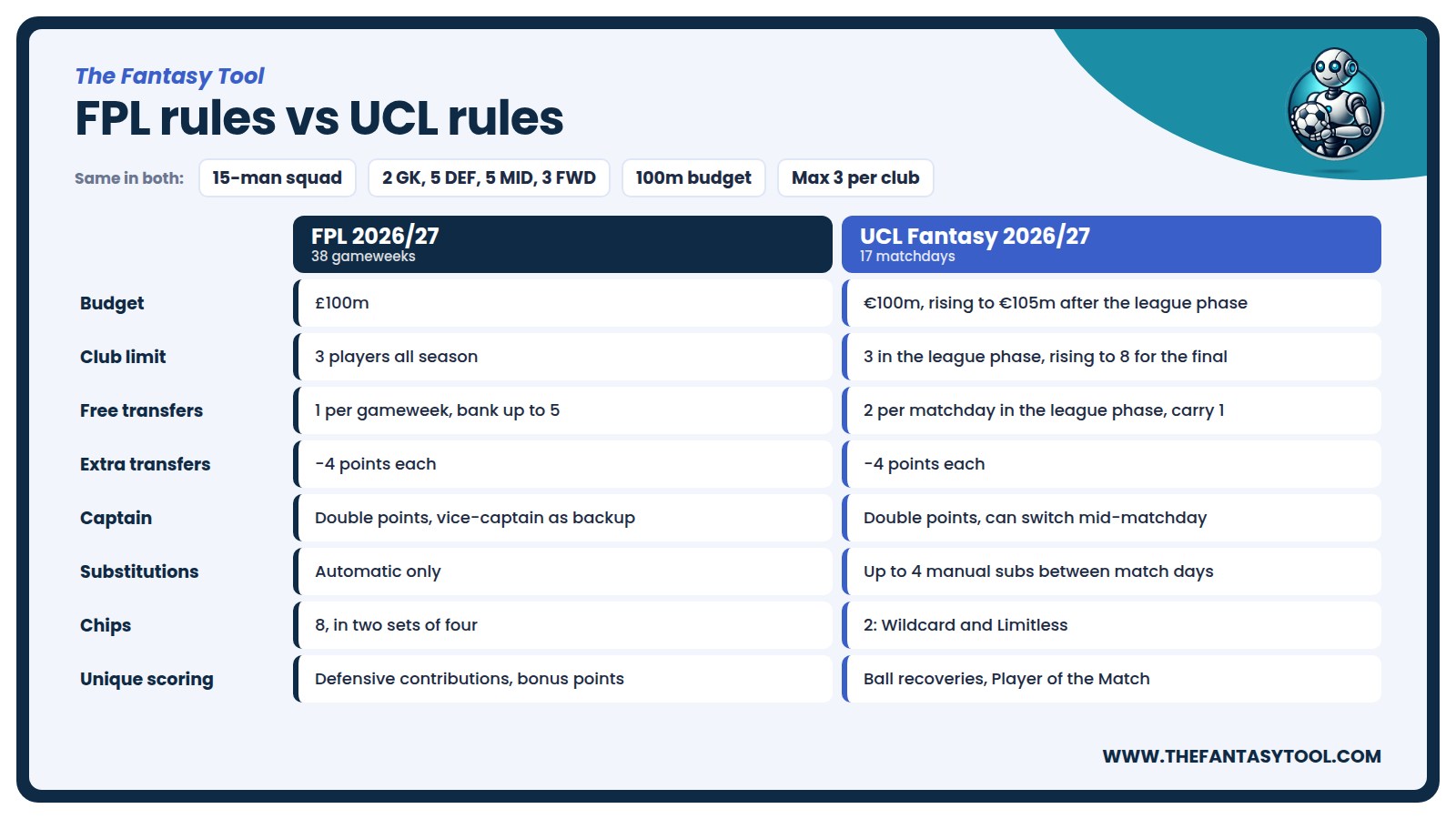
Both games start from the same place: a 15-man squad of two goalkeepers, five defenders, five midfielders and three forwards, a 100m budget and a maximum of three players per club. After that, they split quickly.
Transfers: patience vs volume
In FPL, you get one free transfer per gameweek and can bank up to five. That rewards patience. Managers who roll transfers can react to injuries or fixture swings with several moves at once, without taking a hit.
UCL Fantasy flips that. You get two free transfers per matchday in the league phase, but you can only carry one forward. With just eight league-phase matchdays and unlimited transfers before the knockout play-offs and again before the round of 16, there's little reason to hold back. Use your transfers, because they won't wait for you.
Captaincy and subs: set and forget vs live management
This is the biggest gameplay difference. In FPL, your team is locked at the deadline. If your captain doesn't play, the vice-captain takes the armband, and benched players only come in automatically.
In UCL Fantasy, most matchdays are split over Tuesday and Wednesday. Once the first day's games are over, you can sub out up to four players and switch your captain to someone who plays on the second day. The official UEFA rules even suggest picking a Tuesday captain for exactly that reason: if he blanks, you still have a second chance. On Matchday 2, that second chance could be Mbappé, who TheFantasyTool suggests for its UCL Fantasy XI ahead of Real Madrid's trip to Roma on Wednesday.
Scoring: defensive contributions vs ball recoveries
Goals, assists and clean sheets score almost identically in the two games. Where they differ is in how they reward the players who don't score.
- FPL uses defensive contributions. Defenders earn two points for reaching 10 clearances, blocks, interceptions and tackles in a match. Midfielders and forwards need 12, and ball recoveries count towards their total. On top of that, the bonus points system hands out one to three extra points to the best performers in each match.
- UCL Fantasy has no defensive contribution points and no bonus points system. Instead, every player earns a point for every three balls recovered, and the official Player of the Match earns three extra points. There are also small extras, like a point for scoring from outside the box and two for winning a penalty.
Both systems favour defensive midfielders and busy defenders, but in different ways. In FPL, it's about hitting a threshold. In UCL Fantasy, every three recoveries count, so the points add up steadily.
FPL chips vs UCL chips
Chips are where the two games need completely different plans.
FPL chips 2026/27
FPL managers get eight chips in total, split into two sets of four: Wildcard, Free Hit, Triple Captain and Bench Boost. The first set has to be used before the Gameweek 19 deadline on 2 January, and unused chips don't carry over. The second set covers Gameweeks 20 to 38.
- Wildcard: unlimited free transfers that stay in your squad. Best for a full rebuild after injuries, poor form or a big fixture swing.
- Free Hit: unlimited transfers for one gameweek, after which your squad goes back to how it was. Ideal for blank and double gameweeks.
- Triple Captain: your captain scores triple instead of double. Strongest on a premium player with two fixtures in a double gameweek.
- Bench Boost: points from all 15 players count. Best when your whole squad has good fixtures, especially in a double gameweek.
UCL chips 2026/27
UCL Fantasy gives you just two chips for the whole competition, and neither can be played on Matchday 1, Matchday 9 or Matchday 11, when everyone already has unlimited transfers.
- Wildcard: unlimited free transfers for a matchday, and the new players stay in your squad.
- Limitless: unlimited transfers with no budget limit for one matchday only. After that, your squad goes back to how it was. Think of it as an FPL Free Hit where you can also ignore the price tags.
There's no Triple Captain or Bench Boost in UCL Fantasy. The mid-matchday captain switch does some of the same work, as it gives you two shots at a big captain score.
Chips strategy: how to plan for both games
The key difference is scarcity. FPL gives you eight chips spread over 38 gameweeks. UCL Fantasy gives you two over 17 matchdays, and three of those matchdays already come with unlimited transfers.
- In FPL, the first half of the season usually has fewer blank and double gameweeks, so the first set is often about timing your Wildcard and finding the right single fixtures for Triple Captain and Bench Boost before the Gameweek 19 cut-off. The second set is where cup fixtures create doubles and blanks, and where Free Hit and Bench Boost come into their own.
- In UCL Fantasy, the free transfer windows before the knockout play-offs and the round of 16 work like free Wildcards. That makes the real Wildcard most valuable either during the league phase, when fixtures and form start to separate teams, or later in the knockouts, when only a few clubs remain. Limitless is strongest on a matchday where several elite players have favourable fixtures at the same time, since the budget no longer holds you back.
For UCL Fantasy, TheFantasyTool publishes guides on chip timing, captaincy and how to approach the league phase.
FPL predicted lineups vs UCL predicted lineups
In both games, minutes drive points. A player needs 60 minutes for the full appearance points, and defenders and goalkeepers need 60 minutes to be eligible for a clean sheet. The difference is how much rotation you have to deal with.
- In FPL, predicted lineups matter most around European weeks, cup rounds and international breaks, when managers rest players or deal with fitness concerns. Predicted lineups show each Premier League club's most likely XI, and for Gameweek 6, nailed-on picks include Bruno Fernandes, Virgil van Dijk and David Raya.
- In UCL Fantasy, rotation risk is higher, especially for clubs balancing domestic title races with European ties. The tight deadline adds to it: the matchday locks at the first kick-off on Tuesday, before most confirmed team sheets are out. After the first day, though, you can use Wednesday's confirmed lineups to decide who to sub in.
The predicted lineups are updated throughout the build-up to each round and again once official team sheets are released. TheFantasyTool publishes predicted lineups for UCL Fantasy, and as it points out, being one or two names off in a predicted XI is normal. That's why it shows start percentages rather than a fixed list of eleven names.
Those percentages feed straight into each player's predicted points in UCL Fantasy.